
I am currently in a training on Pathological Love Relationships. I am always in a training of some kind. As I was listening to the beginning lesson, it occurred to me that the model the training is promoting (which is designed for coaching and therapeutic sessions) actually calls out the issues in previous models because it is built on what went wrong.
That same failure is alive in our legal system. Courts and lawyers often misinterpret coercive control as “high conflict” or a dispute between equals. This framing erases abuse and places equal blame on the survivor.
You can subscribe to my Substack here
This is actually supported by the research. Recent family-law scholarship warns that when courts “fail to accurately decipher coercive control from mutual conflict,” custody orders can end up putting children and abused parents in danger. You can view the entire study here.
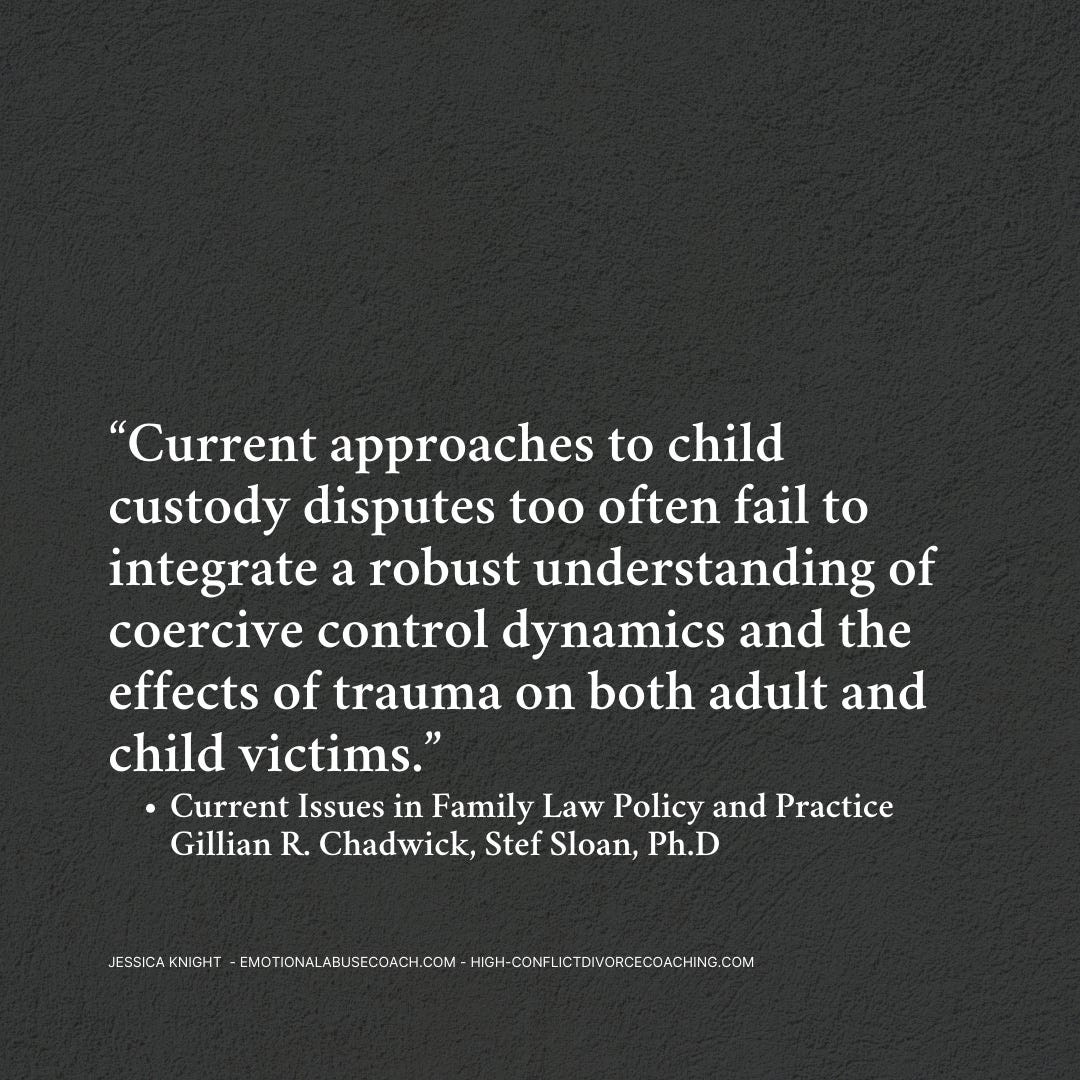
The reality is that most judges and lawyers are not trained to identify patterns of coercive control. Some professionals may hold dual degrees in law and social work, but most do not. Their expertise lies in statutes and precedent — not in the psychological dynamics of abuse. Yet these dynamics are what determine the safety of a child and the wellbeing of a survivor.
This is where subject-matter experts are needed. Just as judges already appoint guardians ad litem or custody evaluators to help them see beyond the “he said, she said” of parenting disputes, courts could also turn to trained experts in coercive control. These professionals could assess whether the relationship dynamics align with established patterns of abuse — offering the court a more accurate, trauma-informed picture.
The Pathological Love Relationships model, though designed for coaching and therapeutic sessions, makes distinctions that the courts desperately need. It identifies four key patterns that reveal the real dynamics of coercive control:
- One spouse shows clear Cluster-B or psychopathic traits.
- The relationship is marked by dramatic, erratic dynamics — love-bombing, gaslighting, isolation, and other extreme swings.
- The survivor possesses “super-traits,” such as unusually high empathy, conscientiousness, or loyalty.
- The survivor’s trauma responses are atypical, often presenting as dissociation, cognitive dissonance, or intense anxiety.
Seen through this lens, what courts label as instability or “conflict” is actually survival in the face of coercive control. If family law practitioners were trained — or if coercive control specialists were appointed — to recognize these four patterns, courts could stop misinterpreting abuse as mutual dysfunction and start protecting the people most at risk.
Below, I’m going to explain the connections I see from the course I’m taking and how these same patterns show up in high-conflict divorce.
The Four Identifiers of Pathological Relationships
When a case is labeled “high conflict,” courts often assume two equally difficult parents. In reality, many of these cases are not about conflict at all — they’re about coercive control. Legal advocates need a way to distinguish the difference. One useful lens comes from the Pathological Love Relationships model, which identifies four consistent patterns:
1. The Cluster-B / Psychopathic Partner
In many high-conflict divorces, one parent shows classic Cluster-B traits — narcissistic, borderline, antisocial, or histrionic. These individuals often appear charming, confident, and persuasive in court, while using manipulation, isolation, and domination behind the scenes. Increasingly, courts are beginning to use the language of “coercive control” to describe this pattern: a course of conduct designed to isolate, dominate, and control a partner. In legal terms, advocates should look for consistent behaviors that strip the other parent of autonomy, rather than isolated arguments or disagreements.
2. Erratic, Dramatic Dynamics
These relationships swing between extremes. At first, the abusive partner may use “love-bombing” — grand gestures, affection, promises of change. But very quickly, this flips into gaslighting, financial control, stalking, threats, or harassment. In practice, these dynamics show up as all-or-nothing thinking, constant blame-shifting, or intrusive behaviors. Survivors often describe a long history of verbal abuse, cyberstalking, and financial withholding before divorce proceedings begin. Yet in court, the shorthand label of “high conflict” can minimize years of abuse into what looks like a personality clash. Attorneys and judges need to see that these dramatic swings are not “normal conflict” — they are evidence of coercive tactics.
3. The Survivor’s “Super-Traits”
Survivors of these relationships often have what researchers call “super traits.” They are unusually empathetic, loyal, and conscientious. They value cooperation and integrity. These are strengths — but in the hands of an abusive partner, they become vulnerabilities. Abusers exploit kindness, loyalty, and a survivor’s willingness to keep the peace. Courts often misinterpret these traits, mistaking a cooperative parent for “co-dependent” or “weak.”
In reality, these qualities are part of why survivors stay, why they try so hard to make the relationship work, and why leaving can feel like a betrayal of their deepest values.
Recognizing these traits matters: they are not pathology. They are evidence of the survivor’s character being exploited.
4. Atypical Trauma Responses
Survivors living under coercive control often don’t present the way courts expect. Instead of calm, linear testimony, they may dissociate, contradict themselves under stress, or appear angry and unstable. Gaslighting leaves them doubting their own memory. Trauma leaves them anxious, forgetful, or reactive.
In a courtroom, this can look like dishonesty or “instability” — when in fact it’s a trauma response. Research shows that domestic violence victims often appear less credible because of how trauma impacts their communication. Courts need to understand that a frightened, halting survivor may be telling the truth, while a confident, composed abuser may be deceiving them.
You can find my work at: High-ConflictDivorceCoaching.com
Courts’ Blind Spots: Where Misdiagnosis Happens
Without specialized training, professionals often misread these four indicators. Common errors include:
- Faulting the Victim: Assuming “it takes two to tango,” and treating both parents as equally responsible for conflict.
- Labeling the Survivor as High-Conflict: Mistaking trauma symptoms for hostility or instability.
- Dismissing Protective Actions as Alienation: Misinterpreting a survivor’s boundaries as “gatekeeping” or parental alienation.
- Credibility Bias: Believing the polished, successful parent over the shaken survivor.
- Undervaluing Non-Physical Abuse: Ignoring coercive control, gaslighting, and financial domination because they leave no visible marks.
These blind spots are not harmless at all. They lead to custody orders that reward abusers and place children in unsafe environments. Survivors may be forced into ongoing litigation, joint custody, or unsupervised visitation with the very person who harmed them.
Without a coercive-control lens, the legal system inadvertently extends the abuse.
The challenge is not whether the patterns exist. Survivors already live them every day. The challenge is whether our courts will learn to see them.
Until judges, attorneys, and evaluators are trained — or until specialists in coercive control are routinely brought into these cases — survivors will continue to be mislabeled, disbelieved, and punished for their trauma responses. And children will continue to be placed in unsafe environments under the guise of “fairness.”
The path forward is clear: family law must catch up to the psychology of abuse.
Tomorrow, I am posting a second piece on the same topic, Courts’ Blind Spots: Misdiagnosis in Practice
You can share this with your attorney if you’d like. They may not read it — or they may skim it and set it aside, but the more this message is repeated, the harder it becomes to ignore. The more it shows up in hearings, motions, and conversations, the more pressure there will be on courts to actually catch up.
These patterns determine whether children are safe, whether survivors are heard, and whether the legal system does its job.
If you’re in the middle of a high-conflict divorce and need more support, I’ve created two step-by-step courses to help you navigate the process:
- Divorcing a Narcissist 101 — a foundational guide for understanding the dynamics and protecting yourself legally and emotionally.
- The Documentation Course — everything you need to gather, organize, and present evidence effectively in court.
You can find both on my course site: jessicaknight.thinkific.com.
For 1:1 coaching, strategy sessions, or more resources, visit high-conflictdivorcecoaching.com.